 Free shipping on orders over $75 across the U.S., with different free shipping promotions available in parts of
 Europe,
 South America,
 Australia.For all other countries, please contact us before placing your order, and we'll be happy to fast-track a shipping solution for you.
Veiled Chameleon: The Ultimate Master of Disguise and Adaptation
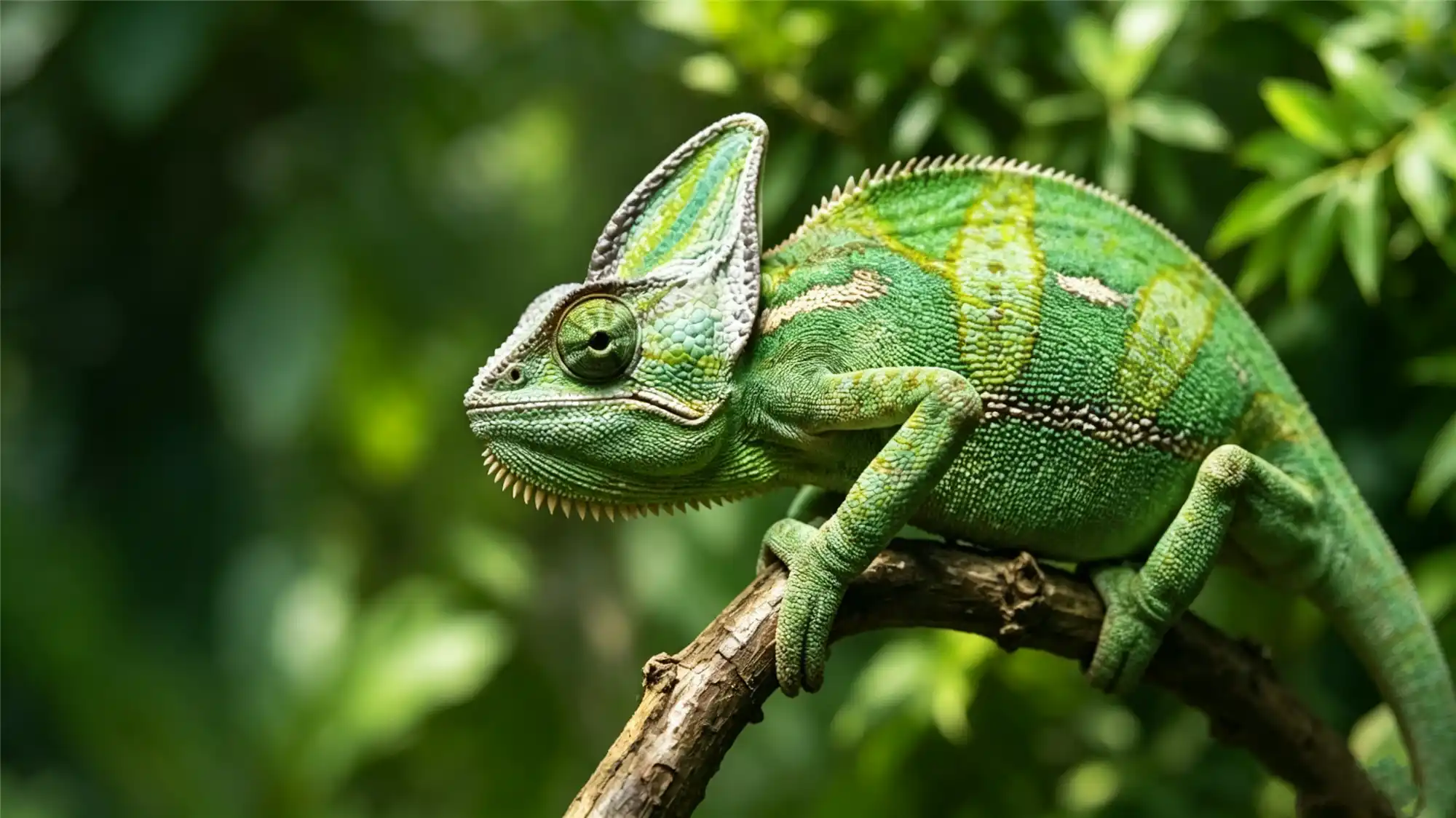
The Veiled Chameleon (Chamaeleo calyptratus) is one of the most striking reptiles in the animal kingdom. Native to the Arabian Peninsula, this species has become a global icon for its dazzling color shifts, independently rotating eyes, and lightning-fast tongue.
But there’s more to this creature than meets the eye. In this article, we’ll explore the biology, behavior, and conservation of the Veiled Chameleon—and uncover why it truly deserves the title “Master of Adaptation.”
What Makes the Veiled Chameleon Unique?
Independent Eyes: 360-Degree Vision
One of the chameleon’s most famous superpowers is its eyes. A Veiled Chameleon can move each eye independently, allowing it to look in two different directions simultaneously. This gives it a nearly 360-degree field of view—a critical advantage for spotting both predators and prey.
Once prey is located, both eyes lock onto the target with stereoscopic focus, providing precise depth perception before the attack.
Color Change: More Than Just Camouflage
Contrary to popular belief, Veiled Chameleons do not change color primarily to blend in with their surroundings. Instead, color change serves three key purposes:
- Communication – Bright colors indicate dominance, territorial claims, or readiness to mate. Males are especially vibrant when courting.
- Temperature Regulation – Darker shades absorb heat; lighter tones reflect sunlight. This helps them thermoregulate in hot desert climates.
- Emotional Expression – Stress, fear, or aggression can trigger sudden color flashes, alerting other chameleons to their mood.
Accurate Hunters: The Ballistic Tongue
A Veiled Chameleon’s tongue can extend 1.5 to 2 times its body length. In a fraction of a second, this sticky, muscular appendage shoots out to capture insects with pinpoint accuracy. Their diet includes:
- Crickets
- Grasshoppers
- Flies
- Caterpillars
- Occasionally, small lizards
This high-speed hunting technique makes them one of the most efficient insectivores in the reptile world.
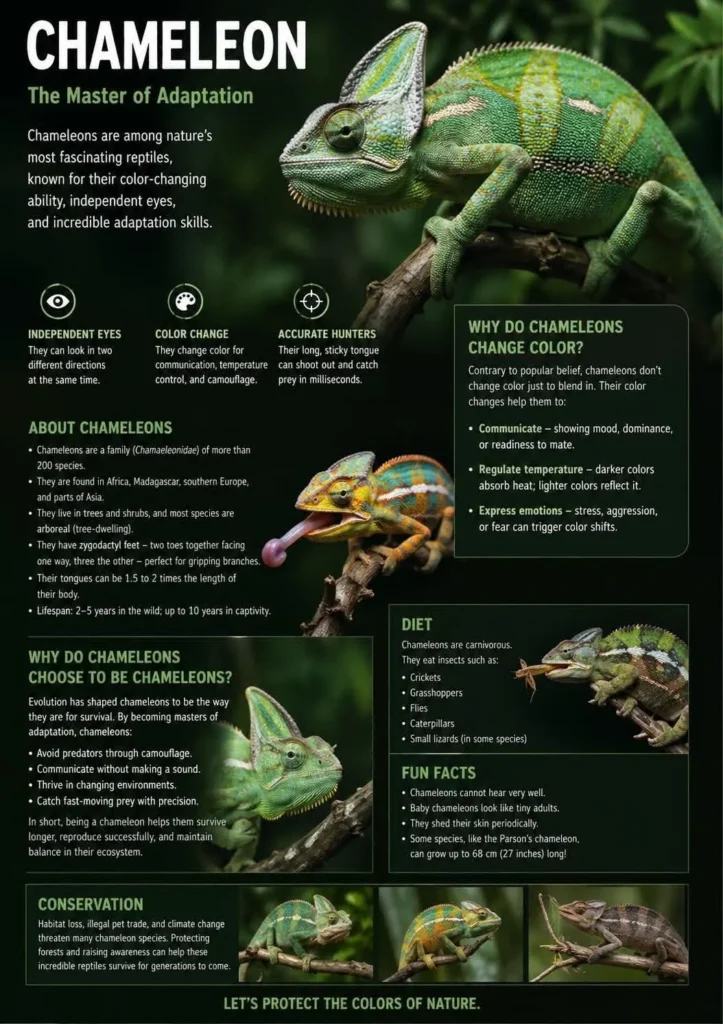
Veiled Chameleon Fast Facts
| Category | Detail |
|---|---|
| Scientific Family | Chamaeleonidae |
| Native Range | Yemen and Saudi Arabia |
| Habitat | Trees, shrubs, arid plateaus |
| Feet Type | Zygodactyl (two toes forward, three backward) – perfect for gripping branches |
| Lifespan in Wild | 2–5 years |
| Lifespan in Captivity | Up to 10 years |
| Max Size | Up to 61 cm (24 inches) for males |
Why Do Veiled Chameleons Choose to Be “Chameleons”?
Evolution has shaped these reptiles into masters of survival. By adapting their color, vision, and hunting tactics, Veiled Chameleons can:
- Avoid predators through rapid camouflage and behavioral shifts
- Communicate without sound—using only skin pigments
- Survive in harsh, changing environments
- Catch fast-moving prey with exceptional precision
In short, every chameleon trait serves a purpose: survival, reproduction, and ecological balance.
Are Veiled Chameleons Good Pets?
Veiled Chameleons are among the most commonly kept pet chameleons, but they require experienced care. They need:
- Large, vertically oriented terrariums
- UVB lighting and temperature gradients
- High humidity and regular misting
- A varied insect diet with proper calcium supplementation
They are not beginner reptiles. Their stress sensitivity and specific environmental needs make them challenging for novice keepers.
Conservation: Protecting the Colors of Nature
Sadly, Veiled Chameleons face growing threats:
- Habitat loss due to agricultural expansion and deforestation
- Illegal pet trade – wild-caught individuals are still traded internationally
- Climate change – altering their native temperature and rainfall patterns
How You Can Help
- Choose captive-bred chameleons over wild-caught
- Support rainforest and mountain habitat conservation
- Educate others about ethical reptile keeping
- Donate to organizations focused on herpetofauna protection
As the infographic says: “Let’s protect the colors of nature.”
Fun Facts About Veiled Chameleons
- They cannot hear well—they rely more on vision and vibration.
- Babies look like miniature adults from day one.
- They shed their skin periodically in patches.
- The largest species, Parson’s chameleon, can reach 68 cm—but Veiled chameleons are still impressive at over half a meter.
Final Thoughts
The Veiled Chameleon is more than a colorful reptile—it is a living testament to evolution’s creative power. From its ballistic tongue to its mood-ring skin, every feature is honed for survival.
Whether you’re a reptile enthusiast, a pet owner, or a conservationist, understanding these creatures helps us appreciate the delicate balance of our ecosystems.